North Cascades National Park Information Page

Welcome to the North Cascades National Park Information Page.
Here you will find all you need to know about the natural history of the park.
Learn about the geology, trees, mammals, birds, or other plants and wildlife of the area.

-SPONSORED LINKS-
North Cascades Lodging
North Cascades Hotels
North Cascades Maps
North Cascades Camping
North Cascades Weather
North Cascades Vacation Rentals
MountainGoat

Sponsored National Park Search

Mountain Goat - Corel ©

North Cascades National Park Information

  • Bears
  • Biodiversity
  • Birds
  • Cougars
  • Establishment
  • Geology
  • Glaciers
  • History
  • Indigenous People
  • Size and Visitation
  • Wildlife
  • Wolves

  • 
    

    Establishment

    North Cascades National Park came into being, officially, on 02 Oct 1968, when Lyndon B. Johnson signed the North Cascades Act. This act created the North Cascades National Park Service Complex which comprised of 684,000 acres of wild land. It also included the park's north and south units, as well as Ross Lake and Lake Chelan national recreation areas. This same act created the adjacent Pasayten Wilderness of 550,000 acres and enlarged the Glacier Peak Wilderness to 464,000 acres. In 1988 Congress designated approximately 93 percent of the three areas as the Stephen Mather Wilderness to provide additional legislated protection. The Cascades were among the world's greatest mountain ranges. Extending from Canada's Fraser River south beyond Oregon, they contribute greatly to shaping the Pacific Northwest's climate and vegetation.


    Size and Visitation

    Acreage - as of September 23, 2000

    Federal Land - 504,575.45
    Non-Federal Land - 205.49
    Gross Area Acres - 504,780.94

    The highest visitation is in August, with the lowest in January. These area average just under 400,000 visitors per year.


    History

    Fur traders, traveling on foot and by canoe, were among the first Euro-Americans to venture into the North Cascades wilderness in the late 1700s.

    Many of the early settlers trapped to supplement their income. Trapping was primarily a winter activity, the most difficult season to be afield in the mountains. The Weaver brothers came to Stehekin primarily to trap animals for a living. They were so successful that they opened a taxidermy business across the river at what is now called Weaver Point. John McMillan, a miner, ran traplines along Big Beaver Creek and the upper Skagit River in the late nineteenth century. Beaver, bear, cougar, wolf, lynx, fisher, marten and fox were all sought by trappers in the North Cascades.

    The earliest recorded crossing of the North Cascades by a Euro-American occurred in 1814. Alexander Ross, a fur trader, crossed Twisp Pass and descended Bridge Creek to the Stehekin River, which he then followed upstream. Finally crossing Cascade Pass, he traced the Cascade River downstream to its confluence with the Skagit River. Maps of Washington Territory in 1860 show large areas still labeled "unexplored." The handful of explorers who followed Ross, also commented on the region's rugged, isolated nature.

    Miners prospected for gold, lead, zinc, and platinum here from 1880 to 1910. They recorded moderate strikes, but transportation proved to be arduous and profits so limited that mining was abandoned. Some logging and homesteading occurred around 1900. The electricity generating potential of the Skagit River was early recognized. Between 1924 and 1961, Seattle City Light built three dams on the river. Mountains do not stop at the park boundaries. The three areas are flanked on the south, east and west by national forest lands and on the north by provincial lands of British Columbia, Canada. The national forest lands encompass a number of outstanding federal wilderness areas, including the Glacier Peak Wilderness on the Baker-Snoquaimie and Wenatchee National Forests. Only an invisible boundary separates the first two national park units from the two national recreation areas and the adjoining national forest lands.

    Evidence of Indian use of the Cascades is widespread, but little is know about it. History has touched little of this area. Today, readily reached areas are heavily visited, but some remote locations have yet to feel the boots of today's backcountry traveler. Forest giants of western red- cedar and Douglas-fir dot the deep valleys. Off the trail, tangled growth's of alder, vine maple, stinging nettles, and devil's club still defy crosscountry hikers. Glaciers scored by crevasses, permanent snowfields, sheer-walled cliffs, spires and pinnacles challenge mountaineers. From North Cascades Highway, on clear days, you may get glimpses of alpine wonders that lie just beyond.

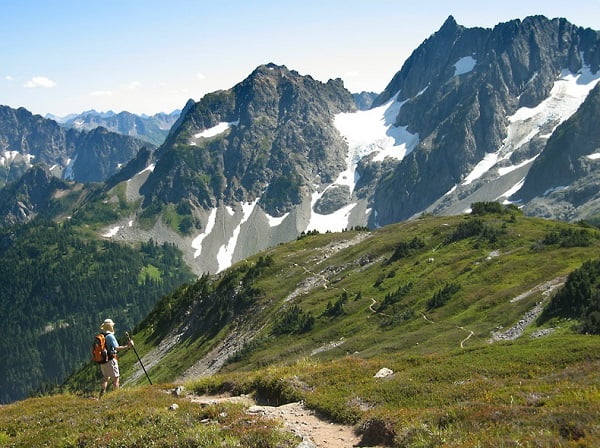
    The Cascade Mountain range runs 500 miles from Northern California to British Columbia, but it is not until it reaches Northwest Washington that the mountains are at their most breathtaking. The Cascades are higher in other parts of the range, but nowhere are they as dramatic. Jagged, rocky peaks of up to 10,000 feet give way to near-sea level valleys; glaciers cling dizzyingly to the sides of foreboding slopes; everywhere waterfalls tumble down from the mountains, the characteristic that gave the Cascades their name.

    Many millions of years ago, before it bumped into North America, this region was an itinerant land mass drifting in the Pacific Ocean. The mountain-building forces at work before and since that unification - accumulation of sediment from pre-historic seas, colliding tectonic plates and volcanic activity - have combined to create one of the fastest growing mountain ranges in the world. Indeed, the North Cascades would be even taller if the counteracting forces of water and glaciers did not conspire to keep the mountains at more modest heights.

    Still, the elevational distance from valleys to summits throughout the North Cascades can exceed 5,000 feet - a relief as great as any other range in the United States. The steep and imposing North Cascades presented a formidable barrier to early white explorers and the names they gave some of these mountains betray their dread: Mt Terror, Mt Challenger, Mt Fury, Mt Despair, Mt Torment, Desolation Peak.


    Indigenous People

    Native people have lived along the Skagit River for many centuries. Many different bands have traditionally occupied the Skagit valley. Today these bands are represented by the Upper Skagits, the Sauk and Suiattle tribes, and the Swinomish. Archeologists have found evidence that the Upper Skagit band lived in the area now called Ross Lake National Recreation Area at least 8,000 years ago.

    The archeology of this area tells the story of a people who lived from the land through fishing, hunting, and gathering. The Newhalem area is a known fishing and hunting area as well as the head of canoe travel on the Skagit River. The name Newhalem is a corrupted Lushootseed word for "place where the goats are snared." (Lushootseed is the language of the native people around Puget Sound.) In the winter, you can often find the mountain goat on the slopes visible from near the North Cascades Visitor Center near Newhalem. The mountain goat provided wool which was used to make clothing and blankets. Newhalem was also a place for salmon fishing. It is evident each autumn, when the salmon are spawning, why the Upper Skagits chose this area to fish. The archeology that has been done in the North Cascades National Park so far has only scratched the surface of the story of these ancestors.

    North Cascades Tribal Use

    Newhalem is only one place that has been traditionally used. Many of the mountains, rivers, and even glaciers around the park still bear the names given by the native people. There were primarily four bands that occupied North Cascades National Park: the Upper Skagit, the Chilliwack, the Nlaka'pamux (Lower Thompson), and the Chelan. There were no absolute boundaries for the bands, but the tribal boundaries did overlap and much trade occurred between tribes. The Upper Skagit people occupied the area along the Skagit River from Diablo all the way down to its mouth. Today's Ross Lake was once the domain of the Nlaka'pamux (Lower Thompson) people. The northern section of the national park around Mt. Baker was used by the Chilliwack tribe. The area around what is now the Lake Chelan National Recreation Area was occupied, as the name suggests, by the Chelan people. Recent evidence suggests that other bands probably used the North Cascades: the Nooksack, Similkameen, Stillaguamish, Methow, and Entiat bands.

    Links with the Past

    Places around the park still bear the ancient names given to them by the native people; for example Sahale, Nooksack, Shuksan, Nohokomeen, Hozomeen, and Stehekin. The Chelan tribe has left some special markings on the cliffs around Lake Chelan known as pictographs. These drawings made with red ocher, a natural form of iron oxide used as a pigment, are a continuing link with the past. A replicated panel of one of the Lake Chelan pictographs can be seen in the North Cascades Visitor Center at Newhalem. The exhibits there display some examples of stone tools and a piece of ocher used by native people of the North Cascades.

    Native People Today

    Native people are very much a part of the Skagit area community. The Upper Skagit Tribal Center is located near Sedro-Woolley, and others make their homes in the up-river areas. The Chilliwack and Nlaka'pamux (Lower Thompson) people continue to live in what is now British Columbia, and some are part of the Stolo Nation. The Chelan tribe is part of the Confederated Tribes of the Colville Reservation. The native people today continue to have a strong tie to their cultural traditions. It is by preserving these traditions and stories that the people continue to survive. Some tribal members still pursue careers in the traditional hunting, gathering, and fishing occupations. Others are artists, lawyers, scientists, clergymen, etc.

    Also today, native people carry on traditional ceremonial practices in the North Cascades, and for this purpose seek pristine ecosystem characteristics, such as are found in the park's wilderness. Increasingly in today's world, the lands are shrinking in size where old-growth cedar and raven ruled. This has affected the traditional practices of native people throughout the Pacific Northwest.

    Additional Reading

    As you explore the North Cascades, remember the ancestors who walked in this area before you and respect their memory. If you would like to know more about the Native American people, please ask a ranger at the Visitor Center front desk to find reading materials and information about classes on subjects ranging from basket weaving to archeology available through the North Cascades Institute.

    If you would like to read more about the native people, here are a few good sources:

    "You must teach your children that the ground beneath their feet is the ashes of our grandfathers. So that they will respect the land, tell your children that the earth is rich with the lives of our kin.... All things are connected."

    attributed to Chief Seattle


    Biodiversity

    The mountain world of the North Cascades is a rich and varied ecosystem - a place bound together by geography and climate and by the interactions of living communities of plants and animals. It is the dramatic variations that we notice first: the sharp contrast between old-growth forests of the river valleys and dwarfed and twisted krummholz trees of a subalpine ridge; the difference between the lush greenery of the west side and drier forests of the eastern slope. Not all the differences between habitats are dramatic, however. Subtle changes may be noticed as one habitat and community grade almost imperceptibly into another.

    The North Cascades ecosystem contains many different habitats. Ecologists compare an organism's habitat to its "address". Habitat is a combination of the physical environment - the rocks and land and water - as well as all the other organisms that live in the same place. Together these plants and animals make up an interacting, interdependent community. These habitats range from the microhabitat of the forest floor, a world of fir needles and decaying wood, home of the centipede and wolf spider, to the trout-filled waters of Berdeen Lake, hidden away in the backcountry and accessible only by days of rugged, cross-country travel. The mountain forests support communities of plants and animals different from those of the river valleys. Plants that flourish in subalpine meadows are strangers to the more severe conditions of alpine ridges.

    As we hike up the river valley toward the montane forest, the plants and animals change around us. The giant ponderosa pines of the lowlands give way to Douglas-fir and Pacific silver fir. The merganser and harlequin ducks of the lower river make way for dippers and spotted sandpipers. As we leave the river behind and climb higher, we enter the subalpine world of meadows and stunted krummholz trees. At the pass, gateway to the peaks beyond, we find ourselves in a different land filled with different creatures - a world apart from the valley still shrouded in mist far, far below.

    Small cushion plants dominate the high meadows with their low growing, prostrate masses of green and brightly colored flowers. Climbing higher, toward the glacial snows, we enter a world of rock and ice. Along the rocky summit ridge of the peak, the only living things we find are lichens, a few insects, and two rosy finches, squeaking as they hop on the topmost crags, oblivious to the precipice below.

    Over millions of years of geologic time, living things adapt to their environment. Every species finds a unique place in its habitat and community. Life is limited by the physical environment (temperature, wind, moisture, space, and length of growing season) and by other organisms (competition and predation). An organism must be able to cope with all of these to survive.

    Few untrammeled wilderness areas remain in the world today; the Pacific Northwest mountains still contain some of those. Many habitats and natural communities have been preserved in as pristine a state as possible in national park or forest wilderness areas. These communities exist now as they have existed for thousands of years. They are living preserves where we can experience the natural world untainted by any direct impacts of industrialized civilization. Unfortunately, indirect effects like acid rain and smog reach and change wilderness areas that are home to many organisms and communities that can exist only in a truly wild state. Further, human presence drives away many species, including the grizzly and the wolf, in search of undisturbed terrain. By learning about and respecting our remaining wilderness areas, we can safeguard those species reliant on them for survival.

    River Valleys and Lakes

    Water is the essence of the North Cascades. Small trickles and rivulets tumble from glaciers and snowfields to join together as rushing creeks. These tributary streams merge into the mighty rivers of the western slope. The east side of the range receives less rainfall and therefore has fewer glaciers, creeks and rivers.

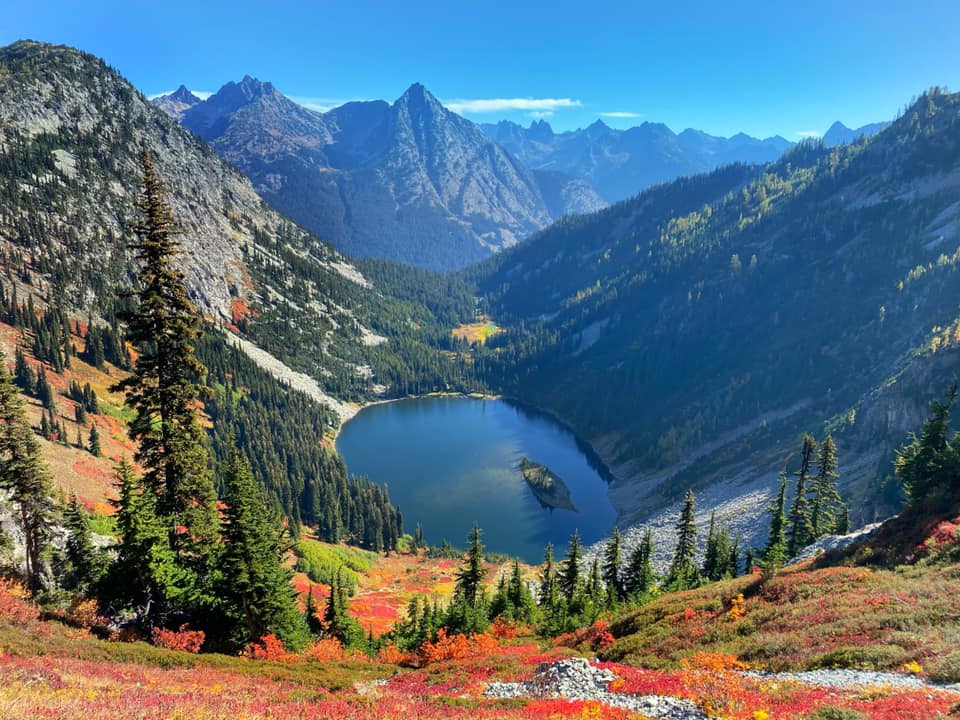
    Hundreds of small lakes, isolated jewels accessible only by arduous cross-country hiking, are scattered throughout the North Cascades. Many of these lakes are tarns, remnants of the alpine glaciers that once covered the North Cascades. Mountain lakes are rich reservoirs of life surrounded by marshes and meadows. Voracious dragonfly nymphs are common in streams and lakes, as are caddisfly and mayfly larvae. Rainbow and cutthroat trout have been introduced into many high lakes, where they feed upon abundant aquatic insects.

    The larger lakes, including Ross Lake and Lake Chelan, host breeding populations of osprey and other fish- eating birds. Common mergansers, large diving ducks, are frequently seen along rivers, as are great blue herons and spotted sandpipers. Osprey fish the rivers and lakes. They dive from hundreds of feet above the water, then rise with a struggling trout clutched tightly in their talons.

    Montane Forests

    Hiking trails wind through most of the major river valleys. Travel off-trail is difficult at best and nearly impossible in many places. River valleys are nearly impenetrable jungles of vegetation. Creeks and streambank habitats are choked with armies of inhospitable brush, including spiny devil's club, prickly currant, salmonberry, thimbleberry and willow. There are tales of mountaineers who spent days trying to bushwhack cross-country out of the Picket Range - crawling through brush that yielded less than a mile's passage for each day's effort.

    Lowland river valleys contain magnificent forests dominated by western hemlock, western red cedar and Douglas-fir trees. While some forests on public and private land are managed for timber harvest and some are managed for multiple use, others are designated wilderness areas. Old-growth stands (also called ancient forests) on public and private lands in the North Cascades are those areas of virgin, uncut forest that contain large, old trees together with trees of different ages. The diversity of age classes in an old-growth forest provides a rich understory and canopy of vegetation. The different levels of canopy allow sunlight to touch the forest floor in places. Old-growth forests also contain snags - standing dead trees - and "nurse" logs that provide shelter for a variety of plant and animal life. Eventually, the snags and logs decompose and become new soil. Some of the last extensive stands of old-growth forest left in the United States are the lowland forests of the Cascade Mountains.

    The greatest concentration of old-growth western red cedar in the North Cascades is found along the lower reaches of Big Beaver Creek below 2,000 feet. Western red cedars are a long-lived species; the oldest are estimated to be over 1,000 years old. Red cedars grow in moist habitats. Thus, they are ideally suited to the North Cascades, where summers are cloudy and winters are mild. Tapering from heavily buttressed bases often over 10 feet in diameter, they rise 200 feet above the forest floor, balanced on a shallow, wide-spreading root system that provides stability in the wet valley soils. They are distinguished by their stringy, fibrous bark, which peels away in thin strips. Lacy sprays of flat needles give western red cedars a delicate appearance despite their great size. Native peoples living on the west side of the Cascades and along the coast used all parts of the "tree of life," making clothing and blankets with the inner bark and totems, dugouts, cooking utensils and lodging with the wood.

    Another dominant tree of the river valleys is western hemlock. Both western red cedar and western hemlock are shade-tolerant; their seedlings thrive in the dense shade of lowland forests. Western hemlocks in an undisturbed area eventually out compete less shade tolerant trees like Douglas-fir to form the climax community of the low-elevation forests of the North Cascades. Growing in scattered, open glades throughout the hemlock forest are red alder and bigleaf maple. These two deciduous trees must have some scattered sunlight for their seedlings to grow. They appear along trails and streams and in openings created when a forest giant falls during a windstorm. Red alder is an important pioneer species that adds nitrogen to the soil through nodules of symbiotic bacteria (mycorrhizae) on its roots. Bigleaf maple is easy to identify with its giant five-lobed leaves spanning 16 inches or more.

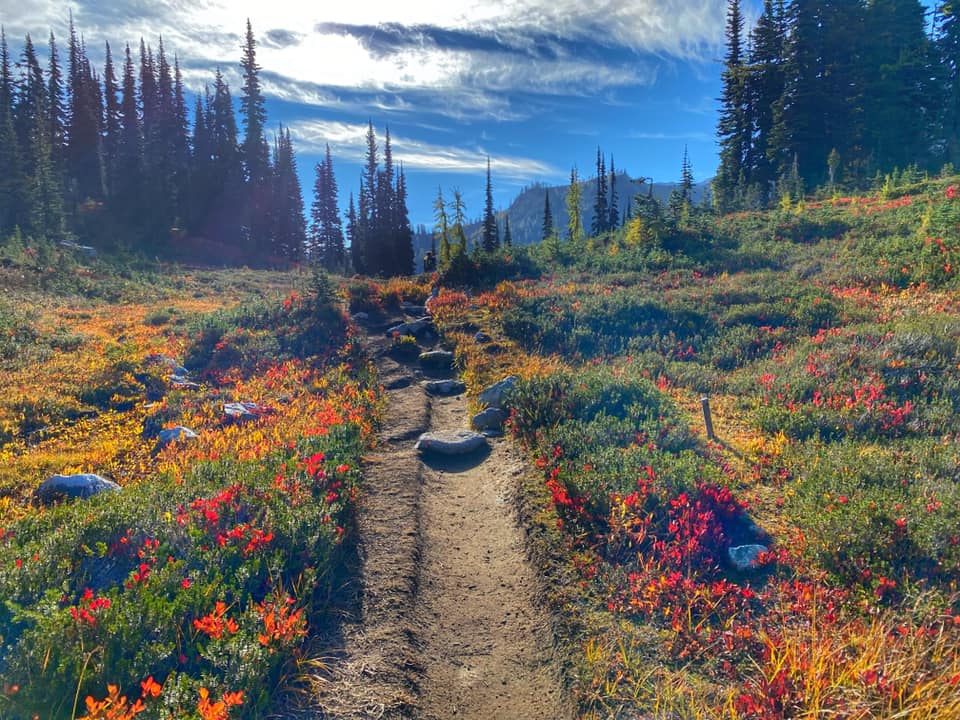
    When walking along a forest trail, occasionally climbing over fallen trees and ducking under low-hanging branches, we see a spectrum of the many shades of green. Huckleberries tantalize the hiker along the trail. In drier locations, salal and Oregon grape, both evergreen shrubs, dominate the understory, while sword fern and its many relatives grow throughout the forest. In springtime the forest floor is thick with wildflowers. Trillium, bleedingheart, yellow violet, calypso orchid, twinflower and arrow-leaf balsam root display their delicate colors and brighten the forest shade. Mosses, lichens and fungi grow thickly over and under the ground and on exposed rocks and fallen trees.

    Only gradual changes in the physical environment and in the plant and animal communities distinguish river valleys from mountain forests. A slight chill in the air is felt that brings an awareness of snowy peaks rising from these mountain forests. As we climb, the land becomes drier and more open. The red cedars give way to a mixture of western hemlock and Pacific silver fir. Red alder, Douglas-fir and Bigleaf maple still grow in sunlit openings.

    Every now and then, a trail crosses an open slope, a remnant of avalanches that thunder down from surrounding peaks every winter. Vine maple and many other shrubs compete vigorously for space and light on these avalanche paths. At about 4,500 feet elevation mountain hemlock replaces western hemlock in the forest canopy, in a silver fir forest.

    On the drier east side of the North Cascades, a similar change is taking place, although different tree species are involved. Douglas-fir and ponderosa pine grow at lower elevations. At higher altitudes western larch, lodgepole pine and Engelmann spruce replace them. Western hemlock and western red cedar are not as common. Black cottonwood and willow line the rivers. With open landscapes and a relative absence of brush, the east side of the North Cascades invites the cross-country explorer.


    Geology
    by Patty & David Bean, Park Naturalists

    The North Cascades are still rising, shifting, and forming. Geologists believe that these mountains are a collage of terranes, distinct assemblages of rock separated by faults. Fossil and rock magnetism studies indicate that the North Cascades Terranes were formed in other places, some many thousands of miles south of here. Attached to slowly moving plates of oceanic rock, they drifted northward, merging together about 90 million years ago. Exactly when they arrived here is still in question.

    Colliding with the North American Continent, the drifting rock masses were thrust up-wards and faulted laterally into a jumbled array of mountains. The collision broke or sliced the terrane into north to south trending faults that are still evident today. Highway 20 crosses the Straight Creek fault just east of Marblemount.

    Geologists believe the rocks to the west of the fault slid more than 100 miles north of the slice to the east. The rocks to the east of Straight Creek Fault are gneisses and granites, while those to the west are completely different recrystallized mudstones and sandstones. Over time, these predecessors to today's North Cascades were further faulted and eroded to a nearly level plain.

    During the past 40 million years, heavier oceanic rocks thrust beneath the edge of this region. Intense heat at great depths caused them to melt. Some of the melt rose to the surface in fiery volcanic eruptions like Mt. Baker. The rest crystallized at various depths to form vast bodies of granitic rock. The North Cascades have again pushed upward to majestic heights, exposing the roots of the ancient collision zone. Ice, water, and wind will eventually level the peaks around us, returning them bit by bit to the sea.

    Scientists agree that the rocks around you comprise some of the most complex and least understood geology in North America. By studying the rock types found in an area and mapping the locations of the rock outcrops, a "geologic picture" slowly takes form.

    For more information on both the variety of rock types here and the North Cascades geologic story, stop by the rock display at the Diablo Lake Overlook at milepost 132 on Highway 20. Also, check out the striking rock outcrop across the highway from the overlook. You can see lighter colored intrusions that were injected into the darker "country" rock. Additional information is available at the North Cascades Visitor Center in Newhalem.

    Sculpting the North Cascades

    The northern Cascade Range is among the youngest mountain areas in the world. The carving and shaping is still actively underway. Moist Pacific air replenishes the mountains with an ample supply of precipitation which is continuously carving stream and river valleys.

    The Skagit Valley to the west is a broad V-shaped valley. At the valley heads, glaciers carved mountains into rugged knife edged ridges called aretes, steep solitary peaks called horns and deep depressions known as cirques. A glimpse into the Pickets and up onto T-bone ridge shows all these elements from Newhalem. Glaciers, moving rivers of perennial ice and their associated formations characterize the mountain range. Glaciers sculpt the mountains and influence the activity of rivers .

    Today, the almost 700 alpine glaciers in the northern Cascade Range are but a fraction of the size of their ice age counterparts, yet account for most of the glaciers in the lower 48 states. Glacial concentrations surround all major peaks. Mt. Baker's slopes support 13 glaciers.

    Glaciers are sensitive to changes in temperature and snowfall. Their constant changes are important climatic indicators. They influence vegetation patterns and serve as reservoirs for domestic and hydroelectric water supplies. In response to cooler summer temperatures and heavier winter snow fall, they have advanced into the head of river valleys several times over the last 800 years. Since about 1900 a general trend of glacial retreat was interrupted by a cooler period in the 1950's when a few advanced.

    Two places to view glaciers closely are at the end of the Cascade River road and near Schrieber's Meadow on the south flank of Mt. Baker. From the Cascade Pass parking lot you can view hanging glaciers on the north face of Johannesburg Peak. These glaciers are carving the mountain into an arete. To view a larger valley glacier go to the south side of Mt. Baker along the Mt. Baker Highway and turn left on forest road 12 and then road 13 to the Mt. Baker National Recreational Area. Hike through Schrieber's Meadow and turn north along the railroad grade moraine until you find yourself staring into the icy blue eyes of the Easton Glacier.

    Rock Thoughts

    In simplest terms North Cascades Geology is not mysterious. Geologists still find its lengthy history intriguing and controversial. Dramatic land form evolution continues with uplift and mountain building.

    Two major volcanic cones lie on the western edge of the range. Mt. Baker and Glacier Peak are among the string of volcanoes lining the edge of the Pacific and known as the "Ring of Fire". Mt. Baker began forming less than a million years ago. Most of it was formed by lava flows but recent activity has been limited to ash and steam. In 1975 the Baker Lake area was closed to visitors due to the increased activity threatening an eruption that could have flooded all of Boulder Creek and Baker Lake. Eruptions were common during the mid-19th century with many documented accounts of activity between 1843 and 1880. The last major lava flow from Mt. Baker occurred 7,500 years ago and extended 12 miles down Sulfur Creek. The core of the northern Cascade Range is bounded by many major fault zones. Thrust faults have scrambled rocks by transporting younger rocks over older ones. In this manner the summit of Jack Mountain was moved nearly six miles. A combination of this uplift and faulting due to intense pressures originating out in the Pacific Ocean, where the Pacific and North American continental plates meet have been responsible for forming the Cascade Range over the last six million years.

    An excellent place to observe the variety of interesting rock forms in the northern Cascades is Diablo Lake Overlook.

    Additional Reading


    Glaciers

    Glaciers, moving rivers of perennial ice, characterize the mountain range and the streams and rivers that emerge below them. Many cascading waterfalls in the North Cascades never run dry. They flow continually because of the enduring contribution of water by glaciers. The 318 glaciers within the North Cascades National Park Service Complex occupy about 60 percent of the total glacier-covered area in the contiguous United States. Today's alpine glaciers have formed on high peaks where more snow falls in the winter than melts each summer. As the snow accumulates and compacts, it eventually begins to flow downhill under its own weight.

    This movement, usually no more than a few feet per year, sculpts the mountains. The North Cascades are characteristically carved into rugged knife edged ridges called aretes, steep solitary peaks called horns and deep depressions known as cirques. A glimpse into the Picket Range and up onto T-bone Ridge shows all these elements from Newhalem.

    During the last ice age, glaciers filled most valleys and covered most of the area with an ice sheet up to a mile thick. Those continental glaciers, bulldozed through the mountains leaving, U-shaped valleys like the Ross Lake basin. These contrast distinctly from the deep, crooked, narrow river-cut canyons like the gorge which begins just east of Newhalem.

    Globally, glaciers store 75% of the world's freshwater. In the North Cascades glaciers contribute 21 billion cubic feet of water every year to streamflow. That is about one-fourth of the total volume of water draining from the North Cascades. Yet, the almost 700 alpine glaciers in the northern Cascade Range are a fraction of the size of their ice age counterparts. Glacial concentrations surround all major peaks. Mt. Baker's slopes support 13 glaciers.

    Glaciers are sensitive to changes in temperature and snowfall. Their constant changes are important climatic indicators. They influence vegetation patterns, move and carve rock, add minerals to the ecosystem, and serve as reservoirs for domestic and hydroelectric water supplies.

    Glaciers have tremendous effects on the hydrology of streams. The most important effects are related to changes in the supply of runoff from melting and the seasonal storage of water within glaciers. In drought years glacial meltwater is the only thing flowing in some streams. Salmon exist in some streams of the North Cascades because of glacial meltwater. Streams that begin as glaciers have water that is typically cloudy and cold.

    The weight of glaciers grind the underlying rock into fine "flour." At Diablo Lake, streams (primarily Thunder Creek) transport suspended particles. When sunlight hits the surface of the lake, it is refracted at a different angle because of the fine rock flourlike particles. As a result, we perceive only the green band of the light spectrum when we view Diablo Lake. this contrasts with the blue water of Ross Lake.

    Two places to view glaciers closely are at the end of the Cascade River road and near Schrieber's Meadow on the south flank of Mt. Baker. From the Cascade Pass parking lot you can view hanging glaciers on the north face of Johannesburg Peak. These glaciers are carving the mountain into an arete.

    Glaciers and Water

    One of the most striking features of the North Cascades is the fantastic number of glaciers in the region. These mountains are home to more than 300 of them - more than half of the glaciers in the contiguous United States. Glaciers are formed when more snow accumulates than melts or evaporates. The weight of this continuous buildup of snow is immense and causes the snow to compact into ice, which then slowly moves downhill. As glaciers move, they gorge the land and redefine the landscape. Mountains may appear to be in suspended animation but, like everything else, they are in a continuous state of change.

    The reason the North Cascades contain such an abundance of glaciers is because Western Washington receives lots of snow, especially in the mountains. Weather moves from west to east across North America, so clouds that pick up moisture in the nearby North Pacific must rise to get over the mountains. As the clouds gain altitude the temperature drops, causing the water vapor to condense and fall to the earth as rain and snow.

    By the time the clouds cross into the rain shadow of the eastern side of the range, they are mostly spent and contain significantly less moisture. The average precipitation on the western slope is 112 in. (280 cm), but the Pasayten Wilderness on the east side averages only 12 in (30 cm).

    Water is the life force of the North Cascades. It falls from the sky, trickles off mountains, replenishes lakes, flows to the sea. Within the Puget Sound watershed, the Skagit is the largest and most bounteous river. With its 2,900 streams, the Skagit River accounts for 20 percent of the water that empties into Puget Sound.

    All five species of salmon and two species of anadramous trout (trout that go from fresh water to salt water and return to spawn upriver) begin life in the cool gravel bottoms of the Skagit River system. In odd-numbered years, as many as one million pink salmon spawn in the Skagit. In 1996, 152,000 Chum salmon - a ten year high - also returned to Skagit.

    Because of healthy salmon runs, the Skagit hosts one of the largest wintering bald eagle populations in the lower 48 states; spawned-out carcasses of Chum salmon are the eagles' most important food source during the winter. In some years, as many as 500 bald eagles spend the winter along the Skagit River.

    Between the craggy peaks and the cool rivers, lush, temperate rain forests blanket the lowlands on the western side of the North Cascades. These forests, which are home to some of the nation's most extensive stands of remaining old growth, produce trees of exceptional size and age. Some Douglas firs, for example, grow to 250 feet and live up to 1,000.

    Western slope forests produce an astonishing quantity of vegetation. In terms of sheer plant volume, the forests of the Northwest are unbeatable; they contain more accumulated biomass than any other forests in the world.

    From rivers to glaciers, valleys to summits, the North Cascades is one of the most extraordinary ecosystems in the world.


    Wildlife

    Bats

    As dusk settles over the forest, they come -- navigating by sonar, silent flyers on leathery wings. Bats: creatures of awe and mystery. There are over 40 species of bats in North America but we know little about them because they are nocturnal. Bats come out when people go in. These small mammals eat more insects by body weight than any other predator, snatching their prey on the wing. Bats roost upside-down in large groups, sleeping all day and hibernating all winter. Some large species native to the Cascades migrate south in the coldest months. Mother bats nurse their young constantly in the first few weeks after birth, when they seldom leave their upside-down perch inside tree cavities or caves, even to feed. Old-growth forest, with snags, tree cavities and loose bark offer important roosting and nesting habitat for bats in the Cascades. Bats have extremely sensitive hearing. They use echolocation to locate prey and navigate, changing the speed and focus of their high frequency "blips" for precise aerial hunting.


    Beaver

    Ten thousand years ago, beavers the size of black bears roamed the continent, and today beavers are still the largest rodent in North America. Beaver sightings are rare, but evidence of their handiwork is common throughout the Cascades: beaver dams, ponds, mounds, and beaver-gnawed trees. Beavers need only hear the sound of running water and the urge to build a dam takes control. Poles, saplings, and mud are dragged and piled into place to form a very efficient structure. Smaller mounds, or lodges, are constructed in the pond as living quarters. Hollow inside, with the entrance underwater, these lodges provide a safe haven from predators. In areas where lodges aren't feasible, beavers construct burrows in river banks. After their pond freezes in winter, the beavers let some water out through the dam, lowering the water level of the pond and providing a "breathing space" between the water's surface and the bottom of the ice. Then they go happily about their business: feeding on poles stashed underwater in the summer, grooming, playing, and sleeping. Hunted and trapped almost to extinction for their pelts, beavers have made a comeback. Persistent and adaptable, they can even be found trying to construct dams near central Seattle and Portland.


    Flying Squirrel

    The flying squirrel is seldom seen because of its crepuscular lifestyle (active in the hours before dawn and after dusk), but it is quite common. Distinguished by huge eyes and velvet-soft fur, this fragile squirrel doesn't really fly, but glides gracefully through the forest, stretching broad flaps of skin between its front and rear legs. In old-growth forests flying squirrels seek out old woodpecker cavities for nesting. Here the babies are safe until their eyes open at one month of age. Unlike most members of the rodent family, these squirrels like meat, but their main food in summer and fall is truffles. Truffles are underground fungi that provide vital nutrients to coniferous trees through a symbiotic relationship. Flying squirrels have an important role in the ecosystem, that of spreading truffle spores throughout the forests. On quiet evenings, you may hear a soft chirp and the thump of a landing as they go about their nightly business of finding food.


    Marmot

    The ultimate sun-worshipper, hoary marmots spend hours sprawled rug-like on rock slabs in the high country, lazily surveying their domain. When hikers appear, marmots are apt to roll a wary eye and contemplate moving rather than making a mad dash for safety. Their high shriek-like call has earned them the nickname whistle-ping although the noise is not really a whistle at all, it comes from the vocal cords. Marmots, the largest member of the squirrel family, excavate intricate burrows and passageways underground. They line their nests with clean dry grass, changed frequently. During the brief alpine summer, marmots put on enough fat to make up half their body weight, then the colony snuggles up together to conserve heat and beds down for about seven months. During rainy interludes they rarely venture out as the marmot's thick, plush coat loses its insulating ability when wet.


    Mountain Goats

    Scrambling across high cliffs and remote peaks, casually edging along precipices inaccessible to other animals, the mountain goat is the ultimate mountain climber. This remarkable animal is actually not a goat at all, but a type of antelope. Their hooves have slightly curved pads that extend beyond the outer shells, which provide them with greater traction and maneuverability than other hoofed animals. Mountain goats have true horns that continually grow and which they never shed. Their pelage (the hair or fur that covers mammals) is white or yellowish-white, with a dense undercoat of soft wool. During the summer mountain goats are very conspicuous as they stand out against the rock terrain, but during the winter they blend in with the snow and are nearly invisible. The pelage keeps the mountain goat warm in clod, dry weather, but it is not as effective when it is cold and wet; during heavy rains, mountain goats often seek shelter under rock ledges or trees. Mountain goats choose to spend most of their time above timberline near rocky outcrops, where they can withdraw to safety in case of danger. When the snow is deep, however, mountain goats will head for the relatively balmy environment of lower elevations.


    Pika

    "Eenk, eenk." Hikers passing talus slopes are familiar with the sound, if not the sight, of the pika, a small relative of the rabbit. The cry is both alarm (they are prey for several predators) and challenge (they are very territorial). When an alarm sounds, pikas disappear instantly into the rock crevices, eluding the hunter. These energetic lagomorphs spend the brief mountain summer gathering mixed greens, dashing about frenetically, then pausing to cast a wary eye around before scrambling off for another load. The plant material they collect is spread on rocks to dry. It's later stacked in rock crevices for storage. Since pikas don't hibernate like most small mammals, this "hay" is their sole source of food during long subalpine winter, lasting 9-10 months in some regions of the Cascades. When you hear the pika's call, stop moving -- stand still, and you may catch a glimpse of this busy harvester.


    Snowshoe Hare

    When all the land is wrapped in snow and most forest creatures are deep in winter hibernation, the snowshoe hare moves silently through the forest. Its large hind feet act like "snowshoes" allowing the hare to move quickly over me snow. And they need to move quickly as foxes, great horned owls, golden eagles, weasels, bobcats, and lynxes all prey on this creature. While the hare's defenses of speed, camouflage, (the brown coat turns white in winter), and alertness are excellent, predatory pressure on them skyrockets during the winter when other small mammals are hibernating. The species survives the winter assault by prolific summer breeding. Females give birth several times a year, producing two to four young, born fully furred and with their eyes open. Hares appear to revel in the warm summer weather, indulging in foot drumming, rough and tumble play, and an ecstatic courtship dance when males and females take turns somersaulting over one another.


    Weasel

    The long, thin body of a weasel is rare among warm-blooded animals -- it's not a heat efficient design. To keep warm, weasels need to eat approximately 40 percent of their body weight every day, more during cold winter months. But the shape is worth the cost -- a weasel can slip into any crevice, flow down any hole after their favorite rodent prey. They are aggressive hunters and seldom lose their quarry once the chase begins. The coat is soft, silky brown in summer and white in winter. Weasels are active year-round, and in winter their white coat makes them almost invisible against the snow. The tail tip stays black and is thought to serve as a decoy. Owls and other predators target the dark tail tip instead of the body and the weasel can usually pull away from a tailhold and escape.


    Bears

    Black bears and grizzly bears can be difficult to tell apart. Size and color are not distinguishing characteristics. Both species vary greatly in the color of their coats: Black bears are not always black, and grizzly bears are sometimes black and not always grizzled. This can make it very difficult to distinguish between the two.

    Black bears and grizzly bears have many things in common. Both sleep through the winter. Both are powerful, fast, and protective of their young. Both species are poached for illegal sale on the black market.

    Both bears eat a variety of foods, most of them plants. Both have good eyesight and an excellent sense of smell; they can detect scents from miles away. Through the course of a year, both bears use a wide variety of habitats, from low valleys to high meadows. Both are highly intelligent and individualistic. Both bears learn quickly how to get food and garbage from people, a habit very difficult to break.

    There are differences between black bears and grizzly bears, too. Grizzlies grow larger than black bears, and, as adults, are not the agile tree-climbers that black bears are. Though not always a definitive characteristic, grizzlies tend to have a concave rather than straight facial profile. Grizzlies a muscular shoulder hump, and longer claws adapted for digging, which they do vigorously. Tracks can also be used to distinguish between the two bears. Grizzly bears can be more aggressively protective of their young and their food than black bears, though you should be very careful in the presence of either.


    Birds

    The abundance and diversity of life are influenced by climate, elevation, soil development and other physical factors, which can be divided into distinct zones. Each zone has its unique complement of continually evolving plant and animal communities. The North Cascades is an excellent showcase of the North American life zone system. From the west slopes' humid river valleys to the east slopes' arid sage brush plains the steep mountain range encompasses five distinct life zones.

    Humid Transition Zone

    The west slope from sea level to about 1,500 ft. is characterized by dense Douglas fir and western hemlock forests. Streamside vegetation includes maple, alder, cottonwoods and dogwood. The understory is dominated by ferns, mosses, mushrooms and flowering plans like Oregon grape, salal, and salmonberry. This zone is home to western Washington's ancient old-growth forests.

    While enjoying these forests along the highway stop, look and listen for spotted, barred and great horned owls, ruffed grouse, band-tailed pigeon, Vaux's swift, pileated woodpecker, Stellar's jay, winter wren, chestnut-backed chickadee, golden crowned kinglet, Swainson's thrush, song sparrow, and purple finch.

    Canadian Zone

    You will notice a gradual change in vegetation types as you enter the Canadian zone from 1,500 ft. to 4,500 ft. elevation. The wet western slopes are dominated by western hemlock, red cedar and silver fir. Lodgepole pine, Douglas fir, and Engelmann's spruce forest dry eastern slopes.

    Birds of this zone include Barrow's goldeneye, red-breasted sapsucker, Stellar's and gray jays mountain chickadee, red-breasted nuthatch, winter wren, dipper, varied thrush, MacGillivray's warbler, Lincoln's sparrow, and red crossbill.

    Hudson Zone

    From 4,500 ft. to timberline you are in the Hudsonian zone. Similar to the northern climes on central Canada, this zone is characterized by mountain hemlock, subalpine fir, and white-barked pine.

    Though no bird species are confined to this zone, typical inhabitants include blue grouse, rufous and calliope hummingbirds, three-toed woodpecker, Clark's nutcracker, Townsend's solitaire, hermit thrush, Townsend's warbler, fox sparrow, and white-winged crossbill.

    Arctic-alpine Zone

    The arctic-alpine zone is that area above timberline that epitomizes the mountainous terrain of North Cascades National Park. Here on the windswept ridges lie alpine meadows of heather interspersed with luetkea, huckleberry, Labrador tea, and a plethora of showy wildflowers. The landscape is dominated by snowfields, rock and ice.

    A few hardy bird species use this zone and include white-tailed Ptarmigan, black swift, common raven, horned lark, water pipit, and rosy finch.

    Arid Transition Zone

    As you descend the east slope of the Cascade Range you enter a ponderosa forest sparsely understoried by Oregon grape, snowberry, wildcurrants, and sagebrush.

    This zone is home to the western screech-owl, common nighthawk, Hammond's and dusky flycatchers, pygmy nuthatch, house wren, gray catbird and Cassin's finch.

    Deep in the wilderness at a wooded mountain lake a melodious call echoes off the cliffs. This is the home of the Common Loon (Gavia immer). If you are fortunate enough to see one, with its zebra-stripe necklace, glossy green checker-board back, and sleek graceful form, you will discover that it looks as beautiful as it sounds.

    The Common Loon breeds here in the North Cascades. However, 'Common' is a misnomer. California and Oregon have no known nests. Washington has only a few. Although dozens of sightings have occurred here in spring and summer, breeding was only recently confirmed.

    Populations of the Common Loon have declined due to human activities and their place high on the food chain. Here their breeding habitat seems relatively secure. However, because loons are migratory and most spend part of each year outside the park, their protection is not ensured.

    Common Loons nest on the ground along lakeshores, on islands, or among wet soggy aquatic vegetation. Females lay 1- 3 eggs in spring following acrobatic courtship behavior. After hatching, the fuzzy young leave the nest in just a few days and are able to swim, dive, and walk. Young loons are vulnerable and fall prey to hawks, mink, turtles, and other predators.

    Common Loons prefer to eat fish, but will settle for a frog, small reptile, insect, leech, or aquatic vegetation. Loons can dive and swim very proficiently. Dives last 0.5 - 3.0 feet.


    Cougars

    Mysterious, enigmatic, secretive -- the cougar weaves in and out of myth and legend like a wisp of smoke. Mountain lion, puma, catamount: many names from many places, all belonging to the cat known in the Pacific Northwest as cougar. To scientists it is known as Felis concolor, or "cat of a single color." In American folklore, it is the ghost walker, ghost of the wilderness.

    Natural History

    Larger than the other two North American wild cats -- the lynx and the bobcat -- an adult cougar may weigh from 85 to 180 pounds. It may reach six to eight feet in length including the thick, expressive, dark-tipped tail which makes up about one-third of its total length. A cougar's coat is typically a tawny color, shading into gray in the northern part of the species' range. The muzzle and chest are white, with a dark triangular marking on each side of the mouth.

    Cougars are primarily nocturnal creatures and, even when active in daylight, they are secretive and rarely seen. They favor dense forest and brush that provides good stalking cover while hunting. Cougars also take advantage of steep canyons and rock outcroppings to remain hidden.

    A cougar is a solitary animal, coming together with another cougar only for mating. Females first breed at 18 to 24 months of age, and litters are born at two- to three-year intervals thereafter. Gestation is 92 days. Cubs are born with blue eyes and a spotted coat; the spots gradually fade and disappear completely by age two. Cubs stay with their mother for up to two years. She is a playful and loving parent, teaching her young what they need to know to survive.

    The cougar patrols a territory of 125 to 175 square miles, with females' ranges a bit smaller than males'. Territories are defended by mutual avoidance rather than direct confrontation. A cougar marks its boundaries with "scrapes" consisting of a mound of dirt and forest litter, urine, and dung. These scrapes serve to warn away other cougars of the same gender, though the ranges of females often overlap males' ranges.

    Cougars eat everything from mice to elk, but deer are their preferred prey.

    The largest cat in North America, cougars once ranged across the continent. Due to aggressive predator control programs and habitat loss, they are now scarce in much of their former range. Though they continue to suffer from habitat loss due to human intrusion, the cougar is not considered a threatened or endangered species.

    Life in the wild is dangerous for a cougar. Free-ranging cougars seldom live more than 13 years. They must find food, mates, a territory, and avoid hunters and other hazards.

    Safety in Cougar Country

    A cougar has all of the grace and playfulness of a house cat; it purrs and has a taste for catnip. Our familiarity with domestic cats can lead to some misconceptions about cougars, however. They are wild animals and must be respected as such.

    Although few people ever see this elusive cat in the wild, sightings and encounters in the national parks have increased in recent years.

    Cougars are entirely capable of lethal attacks on people, and predatory attacks by cougars have occurred across the western U.S. and southwestern Canada over at least the last 50 years. Some incidents occur when people behave in a manner that resembles a cougar's normal prey. Expanding development and subdivisions into cougar habitat, particularly in areas with high deer populations, and residents who leave pet food or small pets or other animals outdoors at night seem to be factors that contribute to increased frequencies of cougar attacks.

    When you visit the backcountry of a Northwestern national park, you are in cougar habitat. Keep this in mind and follow some basic rules.

    For Your Safety

    Never approach a cougar, especially a feeding one.
    Cougars are unpredictable individuals, but will normally avoid a confrontation.
    If you encounter a cougar, be sure to give it a way out.
    Keep children close to you while hiking, and do not allow them to run ahead or lag behind on the trail. Pick them up if you see fresh sign of a cougar.
    Hiking in a small group is best. Particularly in areas where cougars have been sighted, avoid hiking alone.
    Jogging is not recommended. People running or moving rapidly may be at higher risk.
    A walking stick makes a useful weapon in the event of an encounter.

    If You Encounter A Cougar

    Stop. Do not run.
    Immediately pick up small children.
    If you were sitting or bending over, stand upright. Spread your arms, open your coat, try to look as large as possible.
    Maintain eye contact with the cougar, and attempt to slowly back away.

    If A Cougar Acts Aggressively

    Be assertive.
    If approached, wave your arms, shout, and throw sticks or rocks at it.
    If attacked, fight back aggressively.

    An attack from a cougar is an unlikely event and, by taking these precautions, you can reduce the chances even further. By taking care, you will help enable all of us to continue to share America's wildlands with these magnificent animals.

    Outside of national parks, the cougar is listed as a game animal in Washington in most states, so hunting is allowed according to state game regulations. Hunting is not allowed in most units of the National Park System. Campgrounds (Ross Lake NRA)


    Wolves

    Since 1984, wolves have been seen roaming in the vicinity of Ross Lake (Ross Lake National Recreation Area in Washington and Skagit Valley Recreation Area in British Columbia) on both sides of the International Boundary. Wolves were photographed near Hozomeen at the north end of Ross Lake in 1991. Locations of other sightings in the North Cascades include McAlester Pass, Pasayten Wilderness and Twisp River drainage of the Okanogan National Forest, Glacier Peak Wilderness, and Stevens Pass. These wolves are gray wolves, (canis lupus, sometimes called timber wolves). There are probably very few gray wolves in the North Cascades. No one knows whether the population is increasing, decreasing or remaining the same. Wolves have been sighted throughout the Cascade Range and in the Selkirk Mountains in the state's northeast corner.

    In 1990, adults with pups were seen in the Hozomeen area. This was the first known reproduction of wild wolves in Washington State in at least 50 years! Since 1990, biologists have seen three separate groups of adult wolves with pups in the Cascades. Wolves mate in February or March. About 63 days later a litter averaging six pups is born.

    Gray wolves once roamed the continent from as far north as the Arctic to as far south as Mexico. Today they occupy about one percent of their former range in the contiguous United States. More than 1,000 gray wolves live in northern Minnesota. Small populations live in Wisconsin and Michigan. Ten to 15 more live in Michigan's Isle Royal National park and about 30 in or near Montana's Glacier National Park. Gray wolves are common, however, in Alaska and parts of Canada. Wolves migrated from the southern Great Plains into the Cascades. For thousands of years, wolves and humans lived in harmony with each other. Extensive trapping of wolves for their pelts began with the arrival of the Hudson's Bay Company in the American Northwest in 1821. From 1827 thru 1859, buyers at the company's forts around the North Cascades purchased 7,761 wolf pelts from trappers. The wolf population was further reduced by bounties and trappers employed by the government. Wolves were thought to be eliminated in Washington by the 1930's although unconfirmed evidence of transient wolves occasionally turned up in later years.

    As in the United States, wolves were considered undesirable and were aggressively trapped and poisoned in British Columbia. Canada has classified them as big game animals, and they are hunted in parts of British Columbia. Wolf control in southern British Columbia has eased over the last several decades, and according to British Columbian biologists the population of wolves in the province is on the rise. Regulations forbid hunting of wolves just north of the North Cascades National Park/Ross Lake National Recreation Area in the Canadian Skagit Valley Recreation Area and in the Manning Provincial Park. Rapid growth in human population and fragmenting of habitat can have possible long-term negative consequences for wolf populations.

    Wolf Facts

    Wolves have very well developed senses: They can hear rodents moving under heavy snow and other wolves howling from several miles distant. They can smell prey more than a mile away. Wolves run on their toes. This lengthens their legs and makes it possible for them to run faster and turn more quickly. There are probably fewer than 2,500 wolves in the whole United States today, outside of Alaska. Every dog in the world is descended from wolves that were tamed in the Middle East about 12,000 years ago. A wolf's winter coat is very woolly, and can be two and one-half inches thick with individual hairs as long as five inches.

    Wolves look a lot like a big dog -- because dogs descended from wolves. But a wolf has longer legs, bigger feet, and a narrower chest than large domestic dogs. While a domestic dog's tail may curl, a wolf's does not. In distinguishing wolf tracks from those of large dogs, size is ineffective. The "gray" wolf coat may vary in color from pure white to coal black. The usual color is not gray but light tan or cream mixed with brown, black, and white. Much of the black is concentrated on the back, the forehead tends to be brown, and the lower part of the head and body are whitish. Wolves howl, whimper and rarely bark. Their howling is described as haunting by some, mournful by others who have heard them in the wild. The call of adult wolves differs from that of coyotes and dogs. It is a long and clear howl not interrupted by short yaps and barks. Distinguishing wolves from coyotes and dogs is difficult especially when lighting is poor, sighting is brief, or the animal is at a great distance. In general, adult wolves are much larger than coyotes. Coyote colors rarely vary while wolf colors vary widely, and solid-colored wolves are common.

    Coyote: Height at shoulder: 16-20 inches, Weight: 20-30 pounds, Color: All shades of gray and tan, even spotted.

    Wolf: Height at shoulder: 26-34 inches, Weight: 70-115 pounds, Color: Black, white, all shades of gray and tan, grizzled all over, never spotted.

    It must be remembers that although they resemble their domestic cousins, wolves are not dogs. They're wild and meant to stay that way. Nature dictates that the wolf be an efficient predator in order to survive. While fulfilling this role the wolf occupies an important niche in the ecosystem.

    Wolves eat mostly mammals such as moose, elk, deer, beaver and marmot. They were probably the major predator in the North Cascades for thousands of years until the later 19th century. Wolves often eat the sick, weak, diseased, injured, and the very young or old. Removing these animals supports the vigor of the prey species population.

    Wolves live in family groups called packs made up of two to 12 or more members. Packs are governed by an Alpha par, usually the only pair to breed. Although an average of six pups are born, few survive the rigors of their first year. Wolves are highly intelligent and communicate with each other by scent marking, vocalizations, and facial and body posturing. Howling helps them keep track of each other, establish territories, assemble the pack, and defend a kill. They may also sometimes howl just for the fun of it.

    Wolves are being monitored by personal observations and surveys, which include howling, self-activated cameras, and track scent stations. Attempts to radio collar a wolf in the North Cascades have been unsuccessful so far, limiting knowledge of how many wolves are present and what areas they are using. Land managers need accurate and more complete information to better support wolf conservation.

    Future

    Wolves are listed as endangered by the U.S. Fish and Wildlife Service in 47 states, meaning that throughout all or in a significant portion of its range the gray wolf is in danger of becoming extinct. The Fish and Wildlife Service has listed the wolf as threatened in Minnesota, indicating it is somewhat more secure from extinction there. In Washington State, both the federal and state governments list the wolf as an endangered species.

    The Endangered Species Act, passed in 1973, requires the federal government to protect and conserve species threatened with extinction. The Act makes the "take" of wolves a violation. As defined in the Act, "take" means to "harass, harm, pursue, hunt, shoot, wound, kill, trap, capture, or collect, or to attempt to engage in any such conduct."

    It is mandatory under the Endangered Species Act that federal agencies work toward the wolf's recovery. Recovery is defined as having a population of adequate size and composition to make survival over the long run likely. The wolf recovery program for the Northern Rocky Mountains, prepared by the U.S. Fish and Wildlife Service, includes all of Washington State. Specific population goals for the North Cascades have not yet been determined.

    The U.S. Fish and Wildlife Service is the lead agency for protection and recovery of endangered species in the United States. Several natural resource agencies are working toward the conservation and management of the wolves, including: Animal Damage Control, Bureau of Indian Affairs, U.S. Bureau of Land Management, U.S. Fish and Wildlife Service, U.S. Forest Service, National Park Service, the Washington Department of Fish and Wildlife, and the British Columbia Ministry of the Environment.

    Wolves rarely prey on domestic stock, but such incidents do happen. Wolves that kill livestock are removed from the area by experts employed by the federal government. Plans have been developed to deal with problem wolves if livestock losses occur in Washington. The loss of habitat, reduction in prey species, and human-induced mortality are the largest threats to the wolves survival. Attitudes about wolves that stem from stories of "the big bad wolf" and sensational journalism may affect their survival even today. Sources of human-induced mortality include poaching, misidentification as coyotes, or as in British Columbia, through predator control and hunting programs. Wolves in the wild are afraid of humans and generally avoid contact with them. There are no documented instances of healthy wolves attacking humans in North America and only one instance of a rabid wolf doing so. Perhaps some of the widespread fear of wolves is the result of encounters with dogs allowed to run wild. Most places where wolves roam, people are not even aware of their presence.

    It appears that wolves are re-colonizing their former habitat. Wolves' ability to disperse over long distances and reproduce prolifically may enable the species to reestablish itself in Washington.

    This information was provided by the National Park Service


    North Cascades National Park Links
    Bullet Accessibility
    Bullet Activity & Calendar Page
    Bullet Address, Email & Phone Guide
    Bullet Be Bear Aware
    Bullet Biodiversity
    Bullet Bird Information
    Bullet Brochures, Maps, Written Info
    Bullet Biking
    Bullet Boating Guide
    Bullet Camping Guide
    Bullet Cougar Information
    Bullet Establishment
    Bullet Fees
    Bullet Fishing
    Bullet Glaciers
    Bullet Geology
    Bullet Hiking Guide
    Bullet History
    Bullet Indigenous People
    Bullet Jobs, SCA, Volunteer Positions
    Bullet Leave No Trace Principles
    Bullet Location
    Bullet Lodging Guide
    Bullet Map Guide
    Bullet Park Information
    Bullet Permits
    Bullet Pet Information
    Bullet Search
    Bullet Sights Guide
    Bullet Size & Visitation
    Bullet Travel Guide
    Bullet Visitors Guide
    Bullet Weather
    Bullet Wildlife Information
    Bullet Wolves

    North Cascades National Park
    Washington National Parks
    Back to National Parks


    by John William Uhler

    Copyright © 1995 - 2007 Hillclimb Media

    This site is in no way associated with the United States Government, the Department of the Interior or the National Park Service

    Demand Media Knowledge